


Trick or Trick: How Halloween’s Sweetest Night Became Its Scariest
- Oct 29, 2025
- 4 min read
Updated: Jan 13
By: Khadeja Abdel Sattar
Every October, as orange lights glow and plastic skeletons sway in the wind, a quieter chill moves through American neighborhoods, a fear that the candy handed out at dusk might not be safe.
Rumors of laced or tampered Halloween candy have haunted the holiday for decades. Parents inspect wrappers under kitchen lights; police departments post reminders on social media; schools circulate warnings. Yet for all the annual panic, there’s remarkably little evidence to justify it.
Halloween, once the most carefree of nights, has become a mirror for modern anxieties about strangers, safety, and the loss of trust in community.
The Origins of the Fear
The story begins in the 1970s, when several tragic but unrelated incidents involving children and drugs coincided with growing public concern about rising crime and stranger danger.
One case in particular — the 1974 death of eight-year-old Timothy O’Bryan in Texas, poisoned by cyanide-laced candy given by his own father — fused itself into the cultural imagination. The father’s act, meant to claim insurance money, became distorted in retelling: people remembered not a targeted crime, but a random act of neighborhood horror.
“That single event created a myth that’s proven almost impossible to shake,” said Dr. James Alvarez, a sociologist who studies moral panics at the University of California, Irvine. “It combined two of America’s biggest fears — harm to children and betrayal by strangers.”
Media, Memory, and the Making of a Myth
By the 1980s, stories of razor blades hidden in apples and candy laced with drugs spread through local news cycles and talk shows. Though almost every case turned out to be a hoax or misunderstanding, the imagery stuck.
Psychologists call this availability bias: vivid stories dominate memory and shape perception, even when statistically rare. “You’re much more likely to remember a story about poisoned candy than a hundred thousand safe trick-or-treat nights,” said Dr. Carla Nguyen, a cognitive psychologist at Columbia University.
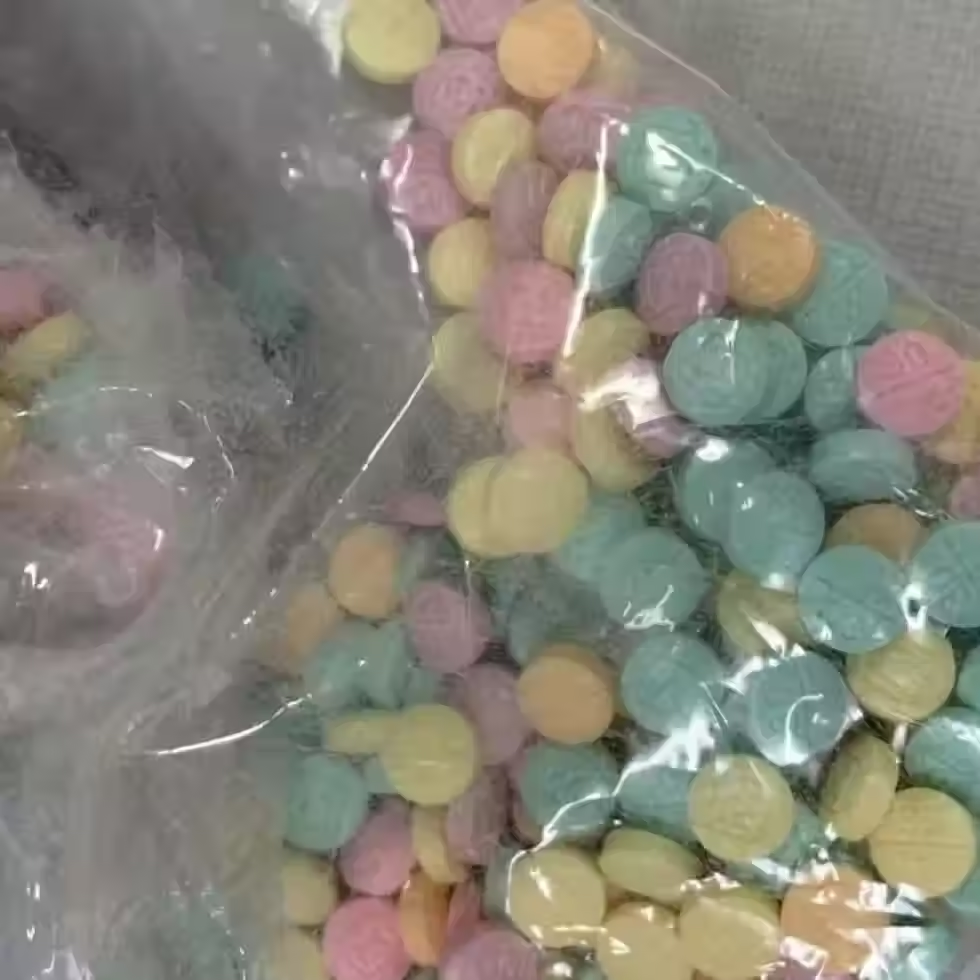
Each year, social media revives the warnings. A single viral post about “rainbow fentanyl” — brightly colored pills that some feared could be disguised as candy — reached millions of users in 2022. Federal agencies clarified that there was no evidence of such targeting, but the fear, once lit, proved hard to extinguish.
The Reality Behind the Panic
In truth, verified cases of strangers intentionally harming children through Halloween candy are extraordinarily rare. Studies by sociologist Joel Best at the University of Delaware, who has analyzed data spanning 70 years, found no confirmed incidents of random tampering resulting in death or serious injury.
Instead, most reports stem from pranks, copycat scares, or unrelated accidents. Candy that “smelled strange” often turned out to be from manufacturing defects, not malice.
Still, the myth persists, fueled by the way fear travels faster than fact. “Halloween is the perfect storm for urban legends,” Dr. Alvarez said. “You have anonymity, darkness, masks, and kids going door to door — all the ingredients of uncertainty.”
Why the Fear Endures
Beneath the myth lies something deeper: a longing for control. For parents, inspecting candy offers a ritual of reassurance, a way to feel agency in a world that often feels unsafe. “It’s less about the candy and more about the culture of vigilance,” said Dr. Nguyen. “We perform safety because it makes us feel safer.”
There’s also a moral component. As Halloween has become more commercialized — filled with store-bought costumes and corporate candy — the myth of the “dangerous treat” taps into nostalgia for a simpler, safer time. Ironically, the act of fear has become part of the holiday tradition itself.
Precautions That Actually Matter
Experts recommend basic, evidence-based precautions — not panic.
Inspect for tampering: Throw away unwrapped or homemade items from unfamiliar sources.
Stick to familiar neighborhoods and accompany young children.
Supervise consumption: Avoid choking hazards and allergens, which are real risks.
Use common sense: If something looks off, don’t eat it.
Health officials stress that these simple steps prevent far more harm than any unproven threat of malicious tampering.
The New Face of Fear
Modern fears have also shifted. Some parents now worry less about candy and more about digital dangers — location-sharing apps, viral dares, and social media exposure. The meaning of “trick or treat” has stretched beyond doorsteps into digital spaces, where misinformation itself has become the real trick.
Yet despite the unease, most families still go out, flashlights in hand and costumes rustling in the dark. The laughter of children echoes down suburban streets, a reminder that collective joy can outlast collective fear.
“Halloween was never meant to be about perfect safety,” Dr. Alvarez said. “It’s about learning to live with the unknown — and doing it together.”
Sweet, Still
So is Halloween scarier now? Perhaps. But the fear says more about us than about the candy. In a culture wired to anticipate danger, even chocolate bars can seem suspicious. And yet, year after year, children keep knocking, buckets in hand, expecting sweetness.
For all its modern anxieties, Halloween endures — not because it’s safe, but because it lets us face fear in a way that’s deliciously manageable.


Comments